

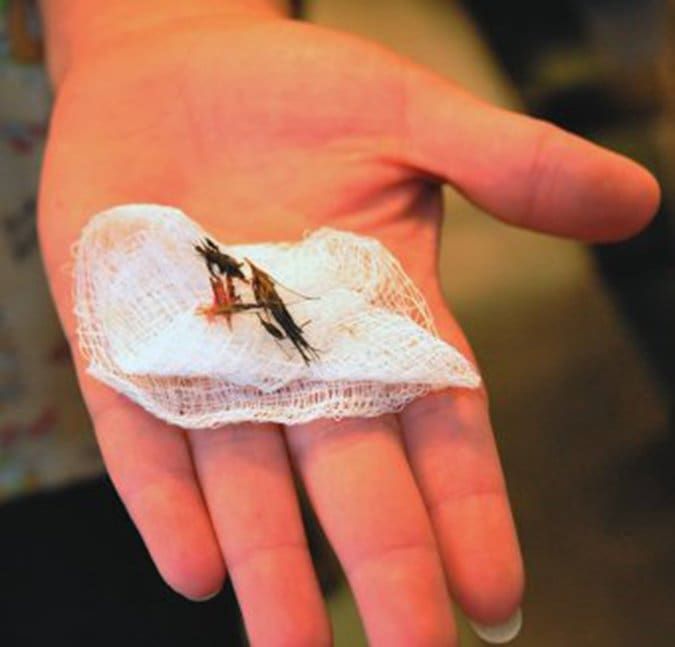
While some first aid may be possible in the event of a foxtail wound, in almost all cases you should get your dog to a veterinarian as soon as possible. Delaying treatment allows the foxtail to do further damage; avoiding foxtail treatment altogether could lead to your dog developing a chronic illness or could even lead to death.
Foxtails in the Eyes
RISKS: Irritation, corneal scratches, ulcers, conjunctivitis, blindness.
SYMPTOMS: Squinting, discharge, an eye glued shut.
FIRST AID: Some trail first-aid advocates suggest removing a visible foxtail in the dog’s third eyelid by hand, by using blunt tweezers, or with a damp Q-Tip. However, you risk not removing it completely or driving it deeper. Instead, keep the dog from pawing at the eye and take her immediately to the vet – ideally to a veterinary opthalmologist.
TREATMENT: With a calm dog, the vet will use a numbing agent on the eye and remove the foxtail. A panicked or excitable dog may need sedation.
Foxtails in the Ears
RISK: Chronic irritation, infections, eardrum damage, deafness.
SYMPTOMS: Head tilting or head shaking.
FIRST AID: Squirting mineral oil into the ear to soften the awn is a common recommendation. But Dr. Randy Acker, author of Field Guide to Dog First Aid: Emergency Care for the Outdoor Dog, cautions against it; if the eardrum has been damaged, the oil will do more harm than good. Get to a vet as quickly as possible.
TREATMENT: The vet examines the ear with an otoscope and uses alligator forceps to extract the foxtail. Sedation may be necessary.
Foxtails in the Nose
RISK: Chronic irritation, infections, tissue damage; may migrate into brain.
SYMPTOMS: Violent, explosive, serial sneezing. There may be a slight bloody dischage.
FIRST AID: None. Get to a vet as soon as possible.
TREATMENT: The dog must be sedated, and a topical anesthetic may be needed to numb the inside of the dog’s nose.
Using a rhinoscope, the veterinarian will visually inspect the area and extract the awn using alligator forceps.
Foxtails in the Mouth or Throat
RISKS: Damage to periodontal pockets, the tongue, or throat; infection; can be inhaled into lung.
SYMPTOMS: Hacking, gagging, difficulty swallowing when eating or drinking.
FIRST AID: If the foxtail is visible, you may pull it out by hand or with blunt tweezers. Feeding the dog bread may force the seed to move through the throat and into the stomach. In any case, see a vet for follow-up.
TREATMENT: The vet will anesthetize the dog and remove any foxtails.
Foxtails in Your Dog’s Paws
RISKS: Abscesses, infections.
SYMPTOMS: Continual licking of the foot or pad, bumpy swelling between the toes, or a small hole.
FIRST AID: If you can see the foxtail, you can try to remove it by hand or by using blunt-tipped tweezers. For embedded foxtails, soaking the paw (plain, warm water, 15 minutes, two to three times a day for three days) may promote the formation of an abscess that will eventually burst and expel the awn. If this happens, continue soaking in antiseptic water for several days.
A veterinary checkup is necessary if the foxtail is not expelled or if you see bumps forming in other areas of the paw or leg – a sign that the foxtail is migrating. Follow up with your vet in any case.
TREATMENT: The vet will locate and remove the foxtail.
Foxtails Under the Skin
RISKS: Infections, irritation, migration through the body; if it penetrates the body wall, it may injure a vital organ or cause secondary infection and abscesses.
SYMPTOMS: A hard bump or lump; may include a small hole in its center.
FIRST AID: None.
TREATMENT: The vet will surgically explore for the foxtail and remove it when found.




I have just got my spaniel back from 5 horrendous day at the vets
She couldn’t breath
After putting a chest tube into her lungs and draining 300ml every 6 hours from her lungs she progressed and has got better and come home she had and is still having huge amounts of antibiotics and pain relief
We got some results back from the lab and it was a bacterial infection linked to foxtail grass seeds!!!!
We didn’t think she was going to survive!!
I’ve already posted this in reply to someone else’s comment, but I’ll say it here again for everyone else wondering what a foxtail looks like:
For those that can’t for whatever reason use google image search, foxtails are essentially the seeds of many types of grasses. Think of the fluffy end of tall grass. Barley is one such example, Foxtail grass being another. When the fluffy seed parts dry out, they fall off the grass stalk in many separate pieces, each shaped like… you guessed it: a fox’s tail. Pointy on one end and sort of frilly on the other. The frills have nearly microscopic barbs on them which prevent the foxtails from being pulled out backwards when they work their pointier end into fur, skin, eyes, etc. As such, they continue to burrow deeper and deeper into their host as they’re manipulated through normal daily activity. If you’ve ever found a stubborn grass seed imbedded in your clothing and needed to push it all the way through the cloth to remove it, it was likely a foxtail. But seriously, just google it and look at a picture.
I appreciate this article. Everyone should know the dangers and symptoms of foxtails in and around your dogs. Unfortunately they grow everywhere where we live (even being in a city) and my dog just got one stuck in her nose today. Very scary. I really wouldn’t even try with the first aid unless you can see it. Or if you live far from your vet, but definitely take them to the vet ASAP
My dog inhaled a foxtaill. He was sneezing for a longer period last night (30 mins or so) and he sneezed out blood also from the nose. I took him to vet in the morning and he put 3 injections for the irritation in the nose. How would i know if the foxtail is still somewhere in my dog? Will he show somehow?
When I rescued my Shih Tzu mix, she had an abscess near her vagina that the vet thought might be an embedded foxtail. He gave her antibiotics and said if it didn’t heal he would have to do exploratory surgery. The antibiotics healed the area and it’s been 4 months since it healed. This Saturday she had a bump that burst by her tail (same side as the location of the prior abscess) when she was getting groomed. It had clear liquid and blood in it. I took her to the vet that afternoon and they said it was a cyst. More antibiotics and some cream. My concern is that the location is directly straight above the spot where the suspected foxtail was. Is it possible for it to travel that far and come out the other end? Could the vet be wrong in his diagnosis of a cyst? She’s not bothered by the spot now and wasn’t bothered by it prior to it bursting.